CHAPTER 1 – The visit.
Unfolding his wallet, Jeb Scout pulled out his ID card, pressed it against the panel beside the door, and glanced up at the camera mounted above. The security here was impressive—multiple cameras, reinforced doors, and several checkpoints before even reaching the main entrance. He waited for the soft click of the lock, then pushed through the double doors and stepped inside.
He walked briskly down the grey corridor ahead of him, then made a sharp right and descended a flight of stairs to the basement level.
“Morning, Rachel,” he said to the woman at the front desk, placing his ID in front of her. “I have an appointment with Mr. Gleeson.” He nudged the card closer so she could verify it. Rachel looked at him briefly, then down at the ID. Jeb noticed the slight lift of her eyebrows before she smiled and began typing. He’d expected more of a reaction to the MI5 crest, though he doubted Rachel was easily impressed; she must meet officers and agents frequently.
“You can take a seat behind you, Mr. Scout. Mr. Gleeson will be with you shortly, he’s just finishing a meeting,” she said, gesturing to the chairs. “Thank you, Rachel.”
Jeb crossed the clean marble floor and sat down. He had been tasked with visiting this research facility to understand the progress of their neurological experiments. He needed to assess the project’s current status and report back.
A few minutes later, he noticed a group of four men approaching. They were the facility scientists, Mark Holden, Mo Farooque, Jason Matthews. They were talking animatedly, shuffling papers, pointing at diagrams. Among them was Mr. Gleeson, nodding along. Jeb stood from the chair and Mr. Gleeson glanced at him, then over at Rachel. “Hello, I’m Jeb Scout. I hope I’m not interrupting anything, we had an appointment today,” Jeb said confidently. Rachel gave Mr. Gleeson a confirming nod. He turned back to Jeb and shook his hand. “Please excuse me, but have we met before?” he asked, brow furrowing. “Ah, my apologies, Mr. Gleeson. The briefing files,” Jeb replied smoothly, he had thoroughly prepared to make a good first impression. “Of course,” Gleeson said, satisfied. “You’re not interrupting anything. We’re here for you, Mr. Scout. Please, follow us. We’ll take you to the first section.”
CHAPTER 2. Project Lion
Jeb joined the group as they moved down another corridor and through a set of thick double doors into a large room filled with neatly arranged tables, specialised equipment, and high‑tech computers. Once everyone was inside, Mr. Gleeson stepped forward and began to speak. “This room is the heart of Project Lion. Have you heard about Project Lion before, Mr. Scout?” he asked, turning to face him with an inquisitive look.
Jeb responded quickly. “The details of your research weren’t in my brief. I haven’t heard of this project. Do you mind running through it with me?” “Of course,” replied Mr. Gleeson, jotting something down with a pen before continuing.
“Fear is the one variable we’ve never been able to control,” he began, folding his hands behind his back as they walked. “Every operative, no matter how skilled, carries an instinctive reflex that overrides logic in high‑pressure situations. Our project aims to map that reflex, understand it down to its smallest electrical impulse, and then learn how to adapt it. Imagine an agent who doesn’t freeze, flinch, or hesitate. Pure decision‑making. No instinct dragging them off course.”
He led the group through the room toward a row of reinforced doors. Above each one, signs read Subject 01, Subject 02, all the way to Subject 06. Mr. Gleeson stopped at the door marked Subject 03.
“Mr. Scout, I want to show you one of our subjects. We’ve been observing Subject Three for a while now. Perhaps you’d like to speak with him?”
Gleeson opened the door. A man sat in a windowless room, bright under harsh overhead lighting. Equipment was stacked neatly in the corner, and screens displayed shifting charts and data. Mr. Gleeson walked up to Subject Three and began a polite exchange of How are you? and How’s your day been? a calm tone, Jeb noted. Then Gleeson stepped aside.
The man turned toward Jeb. Their eyes met. Something in the man’s expression shifted. Was it agitation? Recognition? and he stood abruptly.
Jeb remained calm and stepped forward to introduce himself. “Hello, I’m Jeb Scout, just visiting today and—” The man lunged. His face twisted with sudden, irrational focus as he threw himself at Jeb, hands reaching for his throat. Jeb reacted instantly. He caught the man’s wrist, twisted it sharply, forced him forward, and swept his legs. The subject hit the floor chest-first. Jeb held him there, controlled. “Are the patients usually this violent?” He asked Gleeson through his teeth as he fought against the man on the floor. “Not always!” Gleeson replied, kneeling beside the restrained man. “I’ll take this from here.” Jeb released the subject and stepped out of the room where the other scientists were waiting in the corridor. The door shut firmly behind him.
“The ‘not always’ is a risk to MI5,” Jeb said, his tone even but pointed. “He may have lost his sense of fear, but unpredictable, fearless attacks cannot be a side effect of the final product. Fortunately, I had the training to counter him.” Some scientists nodded; others scribbled notes. Mr. Gleeson reappeared, glancing at his team before turning to Jeb. “Mr. Scout,” he said, smoothing his coat, “I think it’s best we move on to the next part.”
CHAPTER 3 – Project Clarity
Mr. Gleeson led the group down a narrower corridor, the temperature dropping noticeably. The hum of machinery vibrated faintly through the walls. “This section houses Project Clarity,” he said. “Our emotional‑response division.” He stopped at a door marked C‑03 and pressed his palm to the scanner.
“Fear is one thing, Mr. Scout,” he continued. “But emotion—emotion is chaos. It clouds judgment, slows reaction, and breeds hesitation. We’ve found a way to quiet it.”
Inside, the room was lined with glass partitions. Behind each pane sat a subject, motionless except for the faint rise and fall of breathing. Electrodes traced from their temples to a console that pulsed with soft blue light. A technician adjusted dials with clinical precision.
“This is the calibration phase,” Gleeson explained. “We isolate the neural centres responsible for empathy, guilt, and attachment. Once suppressed, the subject can act without distraction.” Jeb watched one of the subjects—a woman in her thirties—speaking softly to a researcher through the glass. Her tone was even, her face serene.
“She’s describing the death of her child,” Gleeson said. “Note the absence of distress.” Jeb nodded. “Efficient.” Gleeson smiled faintly. “Exactly. Imagine an operative who can make any decision, no matter how difficult, without emotional interference.” One of the scientists, Mark Holden, glanced at Jeb. “Doesn’t it bother you?” he asked quietly. Jeb turned his head. “Should it?” Holden hesitated, then looked away.
“Emotion is the last barrier,” Gleeson said. “Once removed, the mind becomes pure logic. That’s why we call it clarity.”
Jeb observed the subjects behind the glass, their calm faces, their steady breathing. No discomfort, no pity. “Shall we continue?” Gleeson asked. Jeb nodded.
CHAPTER 4 – Project Mnemosyne.
Mr. Gleeson led the group away from C-03, his shoes clicking sharply against the polished floor. The scientists followed in a loose cluster, murmuring among themselves, while Jeb walked a half‑step behind Gleeson. They turned down a quieter corridor. “This section houses Project Mnemosyne,” Gleeson said. “Our memory‑modification programme.” Jeb’s attention sharpened. Memory work was rumoured, rarely confirmed.
Gleeson gestured to a reinforced glass door ahead. Unlike the Subject rooms, this one opened into a wide communal space resonating more like a residential lounge than a laboratory. Soft furnishings, warm lighting, a kitchenette, even a bookshelf.
“These subjects are lower‑risk,” Gleeson explained. “They live communally. Their routines are monitored, but not restricted. They’re stable enough to function without isolation.”
Jeb scanned the room. His eyes stopped at a bronze sculpture on a pedestal, next to the bookcases. A large figure with its head bowed, hands pressed to its temples. The plaque read The Weight of Thought. He recognised it instantly, though he couldn’t place where from. Maybe he spent a moment too long looking at it when he heard Gleeson ask “Something wrong, Mr. Scout?”. Shaking his head slowly, Jeb looks back at Mr. Gleeson “It’s the statue,” Jeb answered. “I’m just observing.” Gleeson looked over at the statue as if he were making a mental note. The three other scientists began whispering to each other. Jeb shifted on the spot “And what exactly is the purpose of Mnemosyne?” he asked changing the subject swiftly.
Gleeson clasped his hands together enthusiastically. “Security, Mr. Scout. Purely security. There are times when an individual sees something they shouldn’t. Reads something they shouldn’t. Knows something they absolutely cannot be allowed to keep.” Jeb remained silent. “In the past,” Gleeson continued, “the only solution was… removal.” He said the word lightly, as if discussing a faulty component. “But that’s wasteful. Inefficient. And frankly, unnecessary.”
“The process is non‑intrusive, a combination of guided hypnosis and targeted wave induction. We can suppress, alter, or replace specific memories with remarkable precision.” explained Gleeson. “And what do you use for the replacement memories?” Jeb asked. “Harmless fabrications,” Gleeson said. “A different meeting. A different route home. Or we can implant information like facial recognition of targets, criminals, colleagues. The subject becomes case‑ready in hours.” Nodding approvingly Jeb grinned. “Impressive,” he said.
CHAPTER 5- Identity.
“Thank you all,” Gleeson said as they returned to the front desk. “I believe that concludes your visit, Mr. Scout.”
“Absolutely. I’ll report back to MI5. I’m sure they’ll be impressed.” Gleeson smiled and shook his hand. “A few tweaks here and there. See you again soon.”
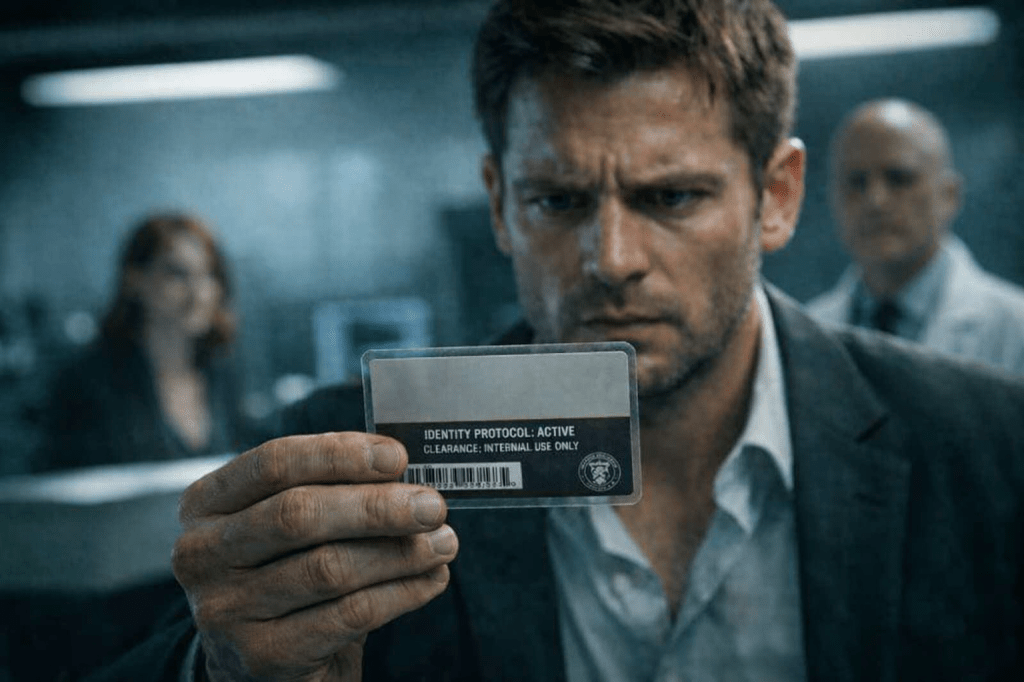
Jeb approached the desk. “Afternoon, Rachel. I’d like to sign out.” Rachel scanned his ID and slid it back to him. “Of course, Mr. Scout.” Jeb reached for it, paying attention to the words on the front. He froze.
The name printed on the card wasn’t Jeb Scout. It wasn’t a name at all.
“SUBJECT 0 IDENTITY PROTOCOL: ACTIVE — CLEARANCE: INTERNAL USE ONLY”
For a moment he simply stared, the edges of the card pressing into his fingertips. A cold clarity settled over him as the day replayed itself in fragments that no longer fit the story he’d believed.
The way he’d greeted everyone by name—Rachel, Holden, Farooque, Matthews, Gleeson—without ever being introduced. The way the scientists followed him, observing. The way he’d reacted to the attack—no fear, no hesitation, no adrenaline. Imagine an agent who doesn’t freeze, flinch, or hesitate. The way he’d stood in the Clarity wing, watching people describe tragedy with perfect calm, and felt nothing at all. The way he recognised the bronze statue with no memory of how.
He looked down at the card again. Jeb swallowed, his pulse steady… too steady.
Even now, faced with the truth, he felt no fear.
SUBJECT 0. The acronym of Jeb Scout stared back at him like a truth he was never meant to see.
He wasn’t here to evaluate the facility. He wasn’t visiting. He wasn’t truly MI5.
He was the experiment.

 Winnie's Dreams
Leave a comment